News
Conference: ‘Biographical Approaches to the Nazi Era in Rhineland-Palatinate’ (9 March 2026 at the Memorial in Hinzert)
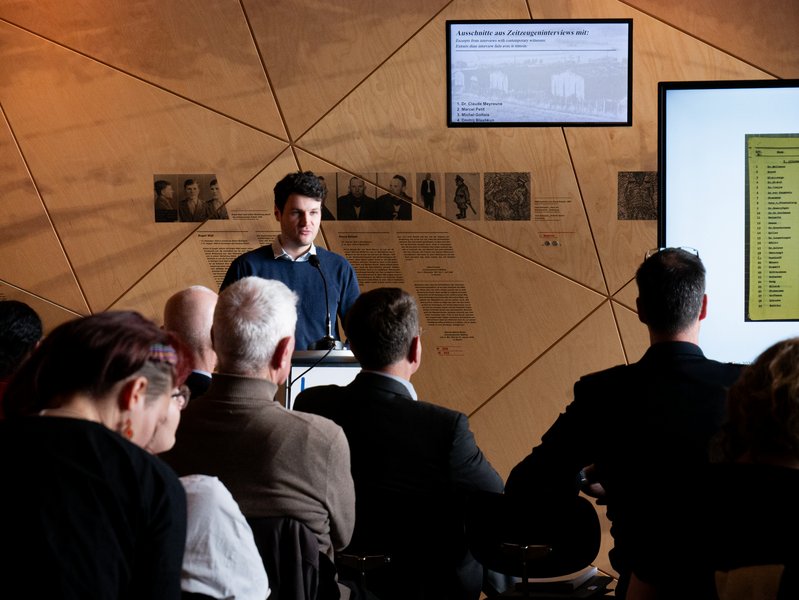
On 9 March 2026, the 11th presentation of the findings from the research project on the history of the Gestapo in Trier took place at the SS Special Camp/Hinzert Concentration Camp Memorial. The well-attended event focused on biographical approaches to the Nazi era in what is now Rhineland-Palatinate. The event, organised jointly by the Rhineland-Palatinate State Agency for Political Education and the SEAL Research and Documentation Centre at the University of Trier, was attended by representatives of the judiciary (Trier Public Prosecutor’s Office) and the police, as well as colleagues from the Saarland, the Grand Duchy of Luxembourg, Belgium and Rhineland-Palatinate. The biographies of Theodor Eicke (who later became commander of Dachau concentration camp and inspector of concentration camps, and who was involved in the Pirmasens bomb affair prior to 1933), Wilhelm Mäurer (the first head of the Trier State Police Station) and Eugen Wipf (the Swiss camp elder at Hinzert) were presented in lectures during the morning, to be explored in greater depth at three thematic round tables after the lunch break. These focused on “Theodor Eicke – A Life’s Journey into National Socialism”, “The Saar Region under Surveillance (1933/34)” and “Functional Prisoners”. Nils Rath, Ulli Backes and Alisa Alić (represented by Thomas Grotum due to illness) presented a multifaceted picture. The Nazi careers of a “failed individual” (Eicke) and an outstanding lawyer (Mäurer) were contrasted, whilst the grey area between perpetrators and victims (Wipf) was examined.
Beyond 20 July 1944 – The Forgotten Resistance | Lecture by Thomas Grotum on the Trier communist Hans Eiden


Federal Minister of Justice and Consumer Protection Dr Stefanie Hubig visits the Higher Regional Court of Zweibrücken in the Palatinate – Lecture by Thomas Grotum

To mark the opening of the travelling exhibition “Die Rosenburg”, the Federal Minister of Justice and Consumer Protection, Dr Stefanie Hubig, visited the Palatinate Higher Regional Court in Zweibrücken. The travelling exhibition forms part of the Federal Ministry of Justice’s efforts to come to terms with its Nazi past. It has been touring the world since 2017 and, following stops in the USA, Israel and Poland, among others, is now visiting Rhineland-Palatinate for the first time.
Following a musical opening, the President of the Palatinate Higher Regional Court, Bernhard Thurn, welcomed those present and emphasised in his welcoming address that “we are living in a time in which our democratic constitutional order is coming under increasing pressure.” This assessment was echoed by Philipp Fernis, Minister of Justice of Rhineland-Palatinate, who explained “that the Basic Law defines a robust democracy and that this ‘Never again’, enshrined in law, must be lived out and defended by everyone”. In her opening address, Dr Stefanie Hubig, Federal Minister of Justice and Consumer Protection, warned: “Democracy and the rule of law are under pressure worldwide. Extreme and authoritarian forces are working systematically to sabotage and discredit the judiciary, parliament and the administration. In view of these dangers, coming to terms with German history remains particularly important. With the ‘Rosenburg’ travelling exhibition, we are sending a message – against forgetting and for a continuous remembrance of Nazi injustice within the judiciary and of the continuity of personnel between the legal profession of the Nazi dictatorship and the early Federal Republic.” Afterwards, the guests listened to further performances by the trio “Les Musiciens du duc Christian” from the Zweibrücken Music School, featuring music by the composer Hans Gál, who himself had suffered under the unjust rule of the National Socialists. In addition, Dr Thomas Grotum’s lecture on the topic “Heinrich Welsch – The Career of the Former Attorney General at the Higher Regional Court of Zweibrücken” provided an opportunity to reflect on the stance and actions of leading figures in the Zweibrücken judiciary at the ducal palace during the Nazi era.
Further information:
The “Rosenburg” is a castle-like country estate in the Kessenich district of Bonn, built in 1831 by the palaeontologist and zoologist Professor Georg August Goldfuß. From 1950 to 1973, it served as the headquarters of the Federal Ministry of Justice (BMJ), and the lawyers working there played a key role in shaping the young Federal Republic. However, the democratic new beginning also took place within the Federal Ministry of Justice, in part with staff who had served during the Nazi era. In 2012, the Federal Ministry of Justice commissioned an investigation to come to terms with its Nazi past. A team of academics led by the historian Prof. Manfred Görtemaker and the legal scholar Prof. Christoph Safferling investigated, through the ‘Rosenburg Project’, how the Ministry of Justice dealt in the 1950s and 1960s with the Nazi past of its staff, the continuities in personnel and policy, the prosecution of crimes related to the Holocaust, and issues of amnesty and the statute of limitations. The findings of the final report, ‘The Rosenburg File’, are currently being presented in the travelling exhibition ‘The Rosenburg’ at the Palatinate Higher Regional Court in Zweibrücken. The exhibition is divided into nine sections and, through the presentation of biographies and original testimonies via display panels and multimedia content, raises awareness of how to deal with historical injustices.
Opening hours for visiting the travelling exhibition:
Monday to Thursday, 8 am to 5 pm
Friday, 8 am to 1 pm
Additional dates:
9–10 January 2026
6–7 February 2026
6–7 March 2026
Fridays from 8 am to 5 pm and Saturdays from 10 am to 3 pm
Links:
Travelling exhibition: www.bmjv.de/rosenburg
Flyer Rosenburg Zweibrücken
Interview mit Lena Haase: Warum Frauen den Holocaust anders als Männer erlebten (SWR-Aktuell) (Kopie 1)

Gedenken an die Opfer des Nationalsozialismus
Interview: Warum Frauen den Holocaust anders als Männer erlebten
Hunger, Erniedrigung und Gewalt mussten alle Inhaftierten in Konzentrations- und Arbeitslagern ertragen. Frauen erlebten den Schrecken dennoch anders als Männer.
SWR-Aktuell | 27.1.2026 | 16:14 Uhr | 10:04 Min.
Von Autor/in: Jeanette Schindler
Der rheinland-pfälzische Landtag gedenkt jedes Jahr am 27. Januar der Opfer des Nationalsozialismus. Und in diesem Jahr stehen zum ersten Mal die verfolgten und ermordeten Frauen im Mittelpunkt. SWR Aktuell hat darüber mit der Historikerin, Dr. Lena Haase von der Universität Trier gesprochen. Sie forscht seit mehr als zehn Jahren zum NS-Frauenlager in Flußbach in der Südeifel.
SWR Aktuell:Frau Haase, lange Zeit wurde die Verfolgung der Frauen in der NS-Zeit kaum beleuchtet. Erst mit der Frauenbewegung in den 80er Jahren hat sich die Öffentlichkeit gefragt: Wie war das eigentlich für verfolgte Frauen, was haben sie erlebt? Sie haben mehr als 1.800 Frauenschicksale erforscht, gab es da eine Gemeinsamkeit, eine Erfahrung die alle Frauen gleichermaßen gemacht haben?
Dr. Lena Haase: Eine ganz generelle Gemeinsamkeit zu nennen, ist schwierig. Aber ich würde anknüpfen an dem, was Sie gerade in der Anmoderation erwähnt haben, nämlich, dass Frauen einfach lange Zeit überhaupt gar nicht im Fokus standen - weder in der Forschung, noch der öffentlichen Auseinandersetzung. Das ist ein sehr typischer Befund, dass Frauen nach '45 ganz gleich, welche Rollen sie vorher gespielt haben während der NS-Zeit, erstmal wieder in ihre ursprüngliche Rolle, häufig als Hausfrau und Mutter wieder zurückgegangen sind. Sie sind wieder hinter die Männer zurückgetreten.
Korinna Schönhärl und Caren Sureth-Sloane: Steuern und Steuergerechtigkeit – Ein Gespräch (Kopie 1)

Korinna Schönhärl und Caren Sureth-Sloane
Steuern und Steuergerechtigkeit - Ein Gespräch
LINK» https://ethik-und-gesellschaft.de/ojs/index.php/eug/article/view/3760
in: ethik und gesellschaft. ökumenische zeitschrift für sozialethik Nr. 2 (2025): Die andere Seite der sozialen Gerechtigkeit: Eine gerechtere Finanzierung steigender öffentlicher Ausgaben
Aus betriebswirtschaftlicher und historischer Perspektive diskutieren die beiden Wissenschaftlerinnen, warum es so schwer ist zu definieren, was steuerlich gerecht ist. Sie überlegen zusammen, wo Probleme des deutschen Steuersystems liegen und wie man diese im Hinblick auf die Gerechtigkeit des Systems bearbeiten könnte. Dabei werden die unterschiedlichen Ausgangspunkte ebenso deutlich wie die Überschneidungsfelder, auf denen Lösungen gesucht und gefunden werden können.
Korinna Schönhärl rezensiert die Studie "Leben auf Kredit" von Felix Krämer (Kopie 1)