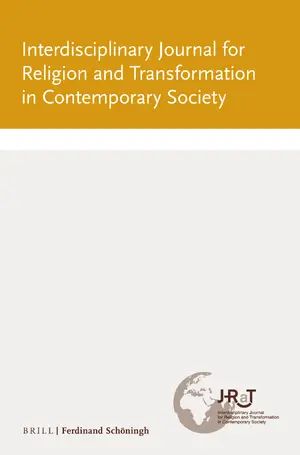
Interdisciplinary Journal for Religion and Transformation in Contemporary Society
Band 12 (2026): Ausgabe 1 (Jul 2026): Special Issue: Religions, Taxes, and Societies in History
https://brill.com/view/journals/jrat/12/1/jrat.12.issue-1.xml (Inhaltsverzeichnis / Table of Content | Download)
Religion und Steuern – was hat das denn miteinander zu tun? Ein Sonderheft der Zeitschrift JRAT geht dieser Frage nach unter dem Titel Religions, Taxes, and Societies in History. Denn Religionen entwerfen immer Visionen eines gerechten Zusammenlebens unter ihren Gläubigen – und dabei spielen Verteilungsfragen eine wichtige Rolle, z.B. durch Steuern. Deshalb haben sich jüdische, muslimische, buddhistische Gelehrte immer wieder zu Steuersystemen geäußert und darüber diskutiert und geschrieben, wie diese Vermögen und Einkommen umverteilten könnten. In unserer online-Präsentation des Sonderheftes am Mittwoch, 7. Oktober um 17.00 Uhr wird der Politikwissenschaftler Philipp Genschel (Universität Bremen) die Beiträge zum Heft kritisch hinterfragen, bevor wir die Diskussion dann für alle Teilnehmenden öffnen. Wir freuen uns auf Ihre Teilnahme unter https://univienna.zoom.us/j/65303526871?pwd=w4uysR3o2YT00TpvWXraQdgVW8hLVU.1
Religion and taxation – what do the two have to do with one another? A special issue of the journal JRAT, entitled ‘Religions, Taxes, and Societies in History’, explores this question – and shows that there are plenty of interconnections. Religions always set out visions of ‘fair’ coexistence amongst men Issues of distribution thus play an extremely important role, for example through the instrument of taxation. That is why Jewish, Muslim and Buddhist scholars had strong views on what tax systems should look like and how they should function, and how much redistribution they should achieve in which way. In our digital special issue presentation on 7 October (5pm), political scientist Philipp Genschel will take a closer look at the contributions: he will pose critical questions to the authors regarding their historical-theological reflections, before we open the discussion to all digital participants. Please join us at https://univienna.zoom.us/j/65303526871?pwd=w4uysR3o2YT00TpvWXraQdgVW8hLVU.1