


News
Introduction of Computer Science as a Mandatory Subject in RLP
Digitalization is increasingly permeating our personal and professional lives, making computer science knowledge a key competency for navigating a technology-driven world securely and responsibly, as well as for achieving professional success.
To ensure equal opportunities and prepare all students for this reality, schools must more strongly integrate the teaching of digital and computer science skills into their educational mission. For this reason, Rhineland-Palatinate will establish computer science as a mandatory subject for grades 7 to 10 in secondary schools, starting with grade 7, beginning in the 2028/2029 school year.
As early as the 2025/2026 school year, schools will have the opportunity to apply for the early introduction of computer science as a compulsory subject. This early introduction will also be possible in the 2026/2027 and 2027/2028 school years. By the 2028/2029 school year, all secondary schools must have either started or be starting with the mandatory computer science subject.
Computer Science at Trier University gets top marks
Master's students of Computer Science have given their studies at Trier University very good marks. As a result, the subject achieved top positions in the recently published CHE ranking. According to the Center for Higher Education Development (CHE), the study program comparison is the most comprehensive and detailed ranking of German universities and colleges. Students of both subjects were asked to rate their degree courses in various categories.
The computer science students awarded their studies at Trier University an average of more than four out of five possible stars in all categories. Prof. Dr. Benjamin Weyers, speaker for Computer Science, attributes this in part to the attractive range of seminars and projects that can be taken during the course. “Our students are quite flexible in their choice of courses and therefore in the areas they want to focus on. We support final theses and projects in cooperation with companies and thus also strengthen the practical relevance.” The megatopic of artificial intelligence is particularly important in teaching and is currently being greatly expanded.
WG 2025 (51st International Workshop on Graph-Theoretic Concepts in Computer Science), 11.06.2025 - 13.06.2025
The International Workshop on Graph-Theoretic Concepts in Computer Science (WG) is an established scientific conference in the field of theoretical computer science and discrete mathematics that takes place yearly since 1975. In 2025, it will be organized by Henning Fernau and Philipp Kindermann at the European Academy Otzenhausen.
WG is mainly concerned with efficient algorithms of various types (e.g., sequential, parallel, distributed, randomized, parameterized) for problems on graphs and networks. The main objective of the conference is to connect theory and applications by demonstrating how graph-theoretic concepts can be applied in various areas of computer science or by extracting new graph-theoretic problems from applications. The research works presented at the conference usually focus on the theoretical background of the problem under investigation as well as the combinatorial and/or algorithmic aspects of the corresponding solution.
Additional information can be found no the conference website: https://algo.uni-trier.de/wg2025/
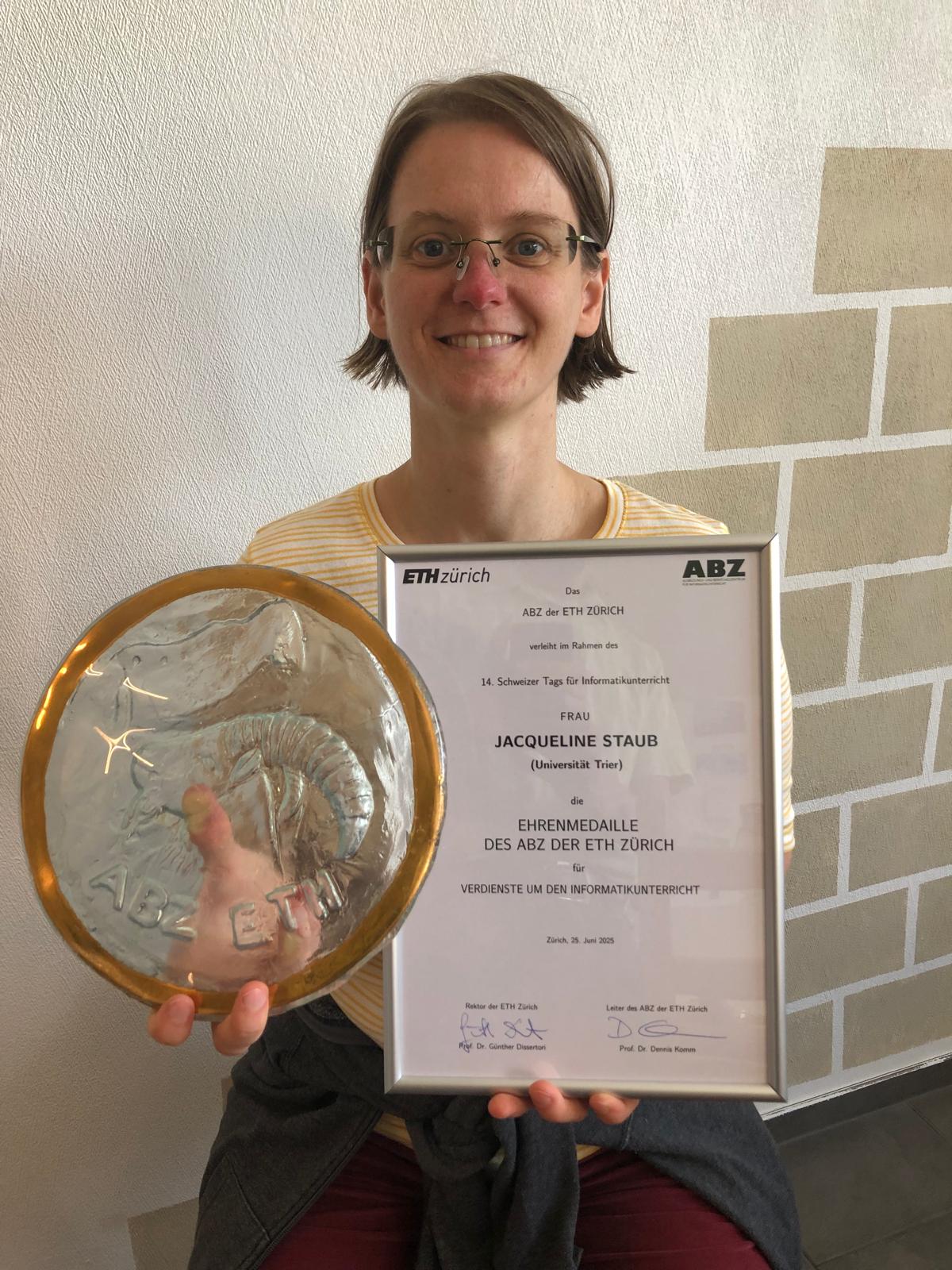
Junior Professor Dr. Jacqueline Staub receives medal of honor for services to computer science education
As part of the 14th Swiss Day for Computer Science Education, Jacqueline Staub was awarded the Medal of Honor for Services to Computer Science Education
by the Rector and the Training and Advisory Center for Computer Science Education at ETH Zurich on 26 June 2025. Photo
Creative Mathematical Sciences Communication CMSC 2024, 07.10.2024 - 10.10.2024
CMSC has quite some tradition. The 7th edition will be held in Trier, Germany, October 7.-10., 2024.
CMSC 2024 is organized by Henning Fernau and Jacqueline Staub, Trier University, as well as by Inge Schwank, University of Cologne, Germany.
It emanated from the "Computer Science Unplugged" initiative of Tim Bells, Mike Fellows und Frances Rosamond.
Fran and Mike also hosted the 6th edition in Bergen.
Get-To-Know-You Day for Students (Takes place every Semester)
Last date: December 14, 2023
On December 14, 2023, the subjects of business administration / economics, computer science / business informatics, mathematics and sociology are organizing an introductory day for students together with the School's Over Team at the University of Trier.
The aim is to find out together whether one of our subjects is the right course of study for you, even if you didn't take a computer science course at school or didn't take the advanced math course.
We have prepared interesting lectures that give an insight into the different subjects and help you choose the best subject for you. A campus tour and a conversation with our students are also planned.
The Program
| 09:00 - 09:30 | Presentation of the University of Trier (HS-12, Campus II) |
| 09:45 - 10:30 | Parallel lectures from business administration and economics (HS-12, Campus II) as well as mathematics and business mathematics (HZ-203, Campus II) |
| 10:45 - 11:30 | Parallel lectures from sociology (HS-12, Campus II) and computer science & business informatics (HZ-203, Campus II) |
| 11:30 - 12:15 | Campus Tour |
| 12:15 - 13:00 | Lunch in the Cafeteria on Campus I |
| 13:00 - 14:00 | Conversations with students (C-22, Campus I) |
>>> Target Group
Our information day is aimed at students and entire school classes who are curious about our subjects. We would like to arouse your interest with practical insights and introduce you to the diverse possibilities of our study programs.
Our goal is to give students with different backgrounds the chance to discover their passion for technology, business, sociology and mathematics. We would like to encourage you to recognize and develop your potential.
We deliberately set this date shortly before the Christmas holidays to give teachers and their classes the opportunity to experience an exciting morning with us.
>>> Registration
Participation in our information day is of course free of charge. A confirmation of participation can be issued for the students. Please let us know in advance how many participants you would like to come to us with so that we can plan the support.
To register, all you need to do is send an email to the economics academic advisor at fsb.vwluni-trierde.