


Archive of Geoinformatics News
10/2026: Seminar by Offer Rozenstein from Tel Aviv
Offer Rozenstein, a colleague from Tel Aviv, will visit Trier and Luxemburg and has kindly offered to give a seminar.
Time and place: 21 September, 15:00 at F14.
Title: Data-Driven Governance from Space: An Applied, Public-Domain AI Engine for National Crop Mapping and Policy Regulation
Click to open Abstract:
Abstract
Optimizing regional resource allocation and national food security requires high-frequency spatial datasets. However, traditional ground surveys are slow and expensive, while administrative land registries often reflect legal ownership rather than actual agronomic boundaries. As a non-commercial, public-domain initiative, we developed CROPMAP, an automated cloud engine that fuses Sentinel-1 SAR, Sentinel-2 multispectral time series, and 0.2 m aerial orthophotos within a unified deep learning framework.
The system combines two main components:
- Dynamic Delineation (U-Net): Separates mixed administrative blocks into true management sub-fields, improving parcel boundary accuracy from 75.16% to 86.37%.
- Hierarchical Classification (Swin Transformer): Resolves sub-pixel canopy variations to simultaneously classify 25 orchard types (up to 98% accuracy) and 17 row-crop typologies (81.15% accuracy).
CROPMAP continuously monitors approximately 435,000 hectares of fragmented agricultural land, automatically updating national inventory layers within 2 to 3 days of new satellite data becoming available. In this seminar, I will share the story behind the development of this operational system, which emerged from urgent regulatory needs and now directly supports national agricultural governance. I will present the multimodal data-fusion methodology, showcase applications developed with the Ministry of Agriculture, including multi-year mapping of uncultivated land and climate-related vegetation metrics, and discuss ongoing work on real-time yield forecasting. I will also highlight opportunities for collaboration in areas such as water-demand modelling and open-source data validation.
08/2026: Geoinformatik stellt sich auf dem Hauptmarkt vor

Mit dem EventLab, dem Cargobike der Uni Trier haben Prof. David Frantz und Kollegen aus der Geoinformatik die Studienmöglichkeiten präsentiert. Mit einer Schatzsuche, Glückskeksen, Stickern und weiteren Goodies gab es für die Studieninteressierten viel zu entdecken.
05/2026: Landsat Science Team meeting at USGS in Sioux Falls, South Dakota.
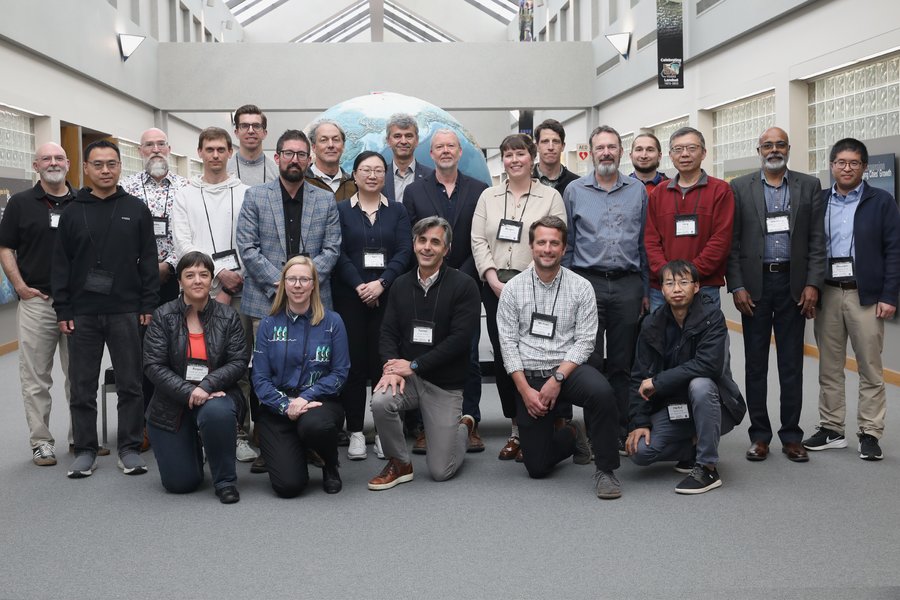
The 2026-2030 Landsat Science Team met for their first in-person meeting May 5-7, 2026 at the USGS EROS Center in Sioux Falls, South Dakota. David Frantz represented Trier University and reported on our goals of developing synergistic data processing pipelines for Landsat and European satellite missions.
GPS tracking reveals complex resource acquisition strategies of pastoralists in East Africa
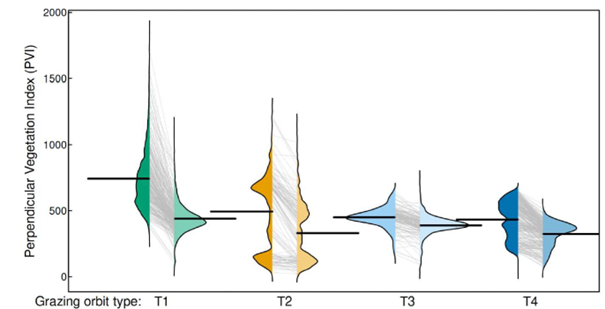
Mohamed Shibia and colleagues have published a paper that shows how pastoralists on the Borana plateau in southern Ethiopia adapt to fluctuating resource availability. They use GPS collar data from 22 cattle herds over a four-year period to generate more than 16000 daily grazing orbits and classify them into resource use strategies. These are linked to Landsat-based grazing resource unit maps to understand which types of grazing units are targeted by the different use strategies.
David Frantz has been appointed as a Member of the new Landsat Science Team

Prof. Dr. David Frantz has been appointed as a Member of the new Landsat Science Team 2026-2030.
He leads a team of investigators in the section Interoperability and Data Processing. Their project is titled “Synergistic data processing pipelines for Landsat and European satellite missions”.
You can find an article in the local newspaper “Trierischer Volksfreund” under the following link:
Tagesschau article about David Frantz's appointment to the Landsat Science Team
Prof. Dr. David Frantz has been appointed as a Member of the new Landsat Science Team 2026-2030.
He leads a team of investigators in the section Interoperability and Data Processing. Their project is titled “Synergistic data processing pipelines for Landsat and European satellite missions”.
The leading German news outlet Tagesschau has published an interview and article on the appointment:
01/2026: David Frantz appointed as a Member of the new Landsat Science Team
Prof. Dr. David Frantz has been appointed as a Member of the new Landsat Science Team 2026-2030.
He leads a team of investigators in the section Interoperability and Data Processing. Their project is titled “Synergistic data processing pipelines for Landsat and European satellite missions”.
An article in the local newspaper Trierischer Volksfreund is titled "Projekt von NASA & Co. – Dieser Mann bringt Trier ins Weltall".
Tagesschau writes about this in “Von der Mosel ins Weltall: Trierer Professor forscht für die NASA”
12/2025: Johannes Stoffels auf der Shortlist für den Lehrpreis
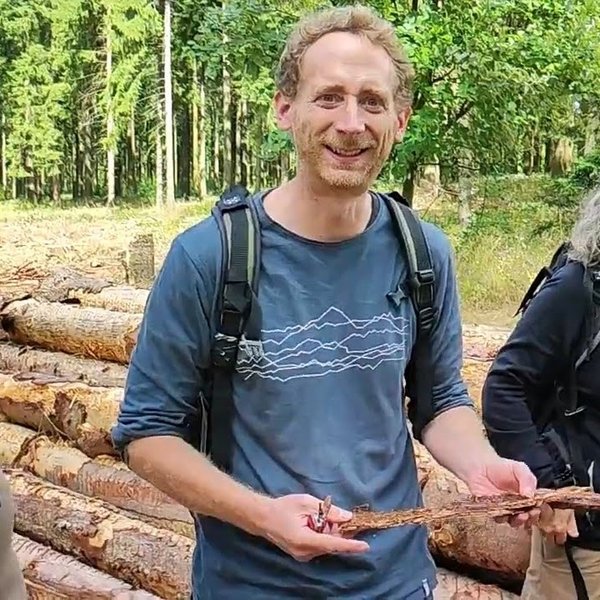
Dr. Johannes Stoffels steht auf der Shortlist für den Lehrpreis der Universität Trier und hat es damit in die zweite Runde für die Preisverleihung geschafft.
12/2025: External Speaker: Dr. Anne Schneibel from DLR

Guest speaker Dr. Anne Schneibel visited our department as part of the colloquium, giving an insightful talk on the Center for Satellite-Based Crisis Information (ZKI). She presented how the ZKI, part of the German Aerospace Center (DLR), uses satellite imagery to provide rapid support during natural disasters and other crisis situations.
11/2025: Contributions to Climate-Resilient Resource Management

The SASSCAL 2.0 scientific conference gathered over 200 experts from Africa and Germany to showcase the results of 13 projects across southern Africa. Achim Röder presented the Geoinformatics Team’s contribution to the ELNAC project, which applies a social-ecological systems approach to improve livelihoods and resource management under climate change. The Trier group develops spatial and temporal data analyses to support science-based management in the Kavango-Zambezi Conservation Area.
09/2025: AK Remote Sensing Conference in Bochum
Marvin Bock, Rodrigo Velarde Jara, and David Klehr presented their latest research at the AK Remote Sensing Conference in Bochum. Their contributions cover a wide spectrum of current topics in remote sensing, including tree species mapping, the integration of workflow management systems, and applications for biodiversity monitoring.
05/2025: Neue Publikation

David Klehr, Johannes Stoffels, und David Frantz haben den Artikel "Mapping tree species fractions in temperate mixed forests using Sentinel-2 time series and synthetically mixed training data" im Journal Remote Sensing of Environment publiziert. Der Artikel thematisiert die Klassifiaktion von Sub-Pixel Anteilen von Baumarten in den Wäldern von Rheinland-Pfalz.
03/2025: Zweiter Forschungsband des Nationalparks Hunsrück-Hochwald erschienen.

Im Forschungsband des NLPHH gibt es mehrere Beiträge aus dem Fachverbund Geoinformatik.
10/2024: Sascha Willmes im Trierischen Volksfreund zum Golfstrom
Für einem Artikel zur Gefahr einer nachlassenden nordatlantischen Umwälzströmung (AMOC) hat der Trierische Volksfreund mit Dr. Sascha Willmes gesprochen.
09/2024: Projekt "BrandSat" in konzenTRiert

In der Uni-Zeitschrift konzenTRiert erschien ein Artikel über unser Projekt BrandSat, in dem ein Konzept erarbeitete wurde für einen hochaufgelösten Waldbrandgefahrenindex, der mit Satellitendaten die aktuelle Trockenheit der Baumkronen mit einbezieht.
01/2023: Beiträge zum Projekt "PapyHyp" in der Süddeutschen Zeitung und in Sat.1

Über das Projekt Papyhyp (gefördert durch die Nikolaus-Koch-Stiftung) wurde mehrfach in der Presse berichtet, unter anderem in der Süddeutschen Zeitung.
In Sat.1 ist in der Sendung "17:30 Rheinland-Pfalz und Hessen" ein Beitrag zum Projekt PapyHyp erschienen: https://www.1730live.de/whatsapp-der-antike-trierer-forscher-digitalisieren-uralte-papyrus-texte/
Und auch die Uni-Zeitschrift konzenTRiert berichtet über PapyHyp.